FROM COCOON TO SILK.
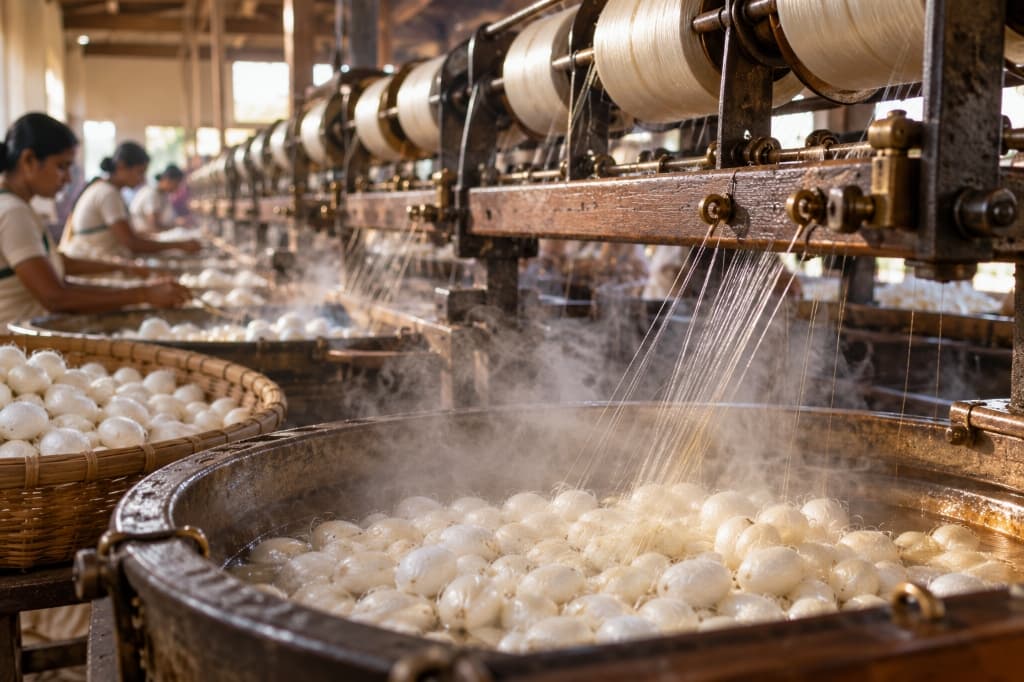
Mulberry Cocoons from Karnataka Sericulture
Cocoons described as coming from Ramanagara, then moving to T. Narasipura.
Cocoons are bought at the Ramanagara silk market and taken to the raw silk unit at Tirumakudalu Narasipura.

Filature Reeling at T. Narasipura
Cocoons are soaked and boiled, then reeled into raw silk yarn.
Cocoons are soaked and boiled, then reeled into raw silk yarn on imported reeling machinery.
High-Speed Twisting & Winding
Twisted for the crepe texture, then sent to Mysore.
Yarn is twisted 2,200 times per metre for the crepe texture, with 26/28-denier warp and two-ply weft, then sent to Mysore.

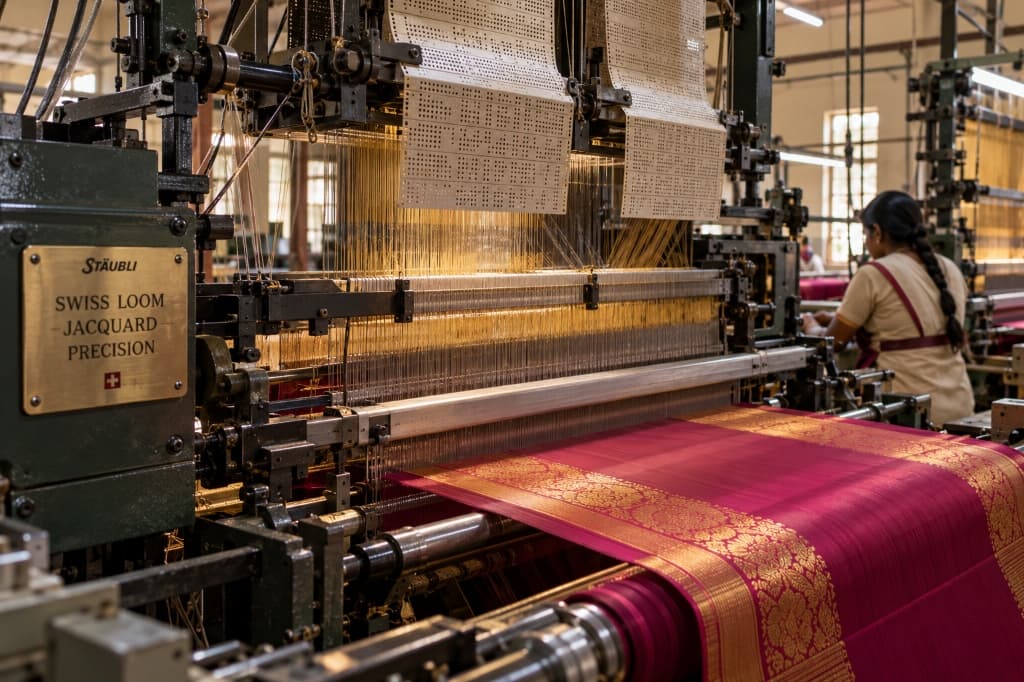
Dobby, jacquard, and later machinery
Patterned silk at the Mysore weaving factory. Not described as one process for every saree.
Sarees are woven on dobby, jacquard, and e-jacquard looms fitted with prepared patterns.
Washing after weaving
Degumming is described for woven sarees, not as a step that every dyeing fault repeats.
More than 200 sarees are soaked in boiling soap and soda ash, rinsed in warm water, then hydro-extracted.

Colour after degumming
Even dyeing is described. Bleaching is described only where a dyeing fault occurs.
Winch machines turn the sarees in hot water linked to a colour tank. A faulty dyeing is bleached, dyed again, and washed.

Finishing, code, and dispatch
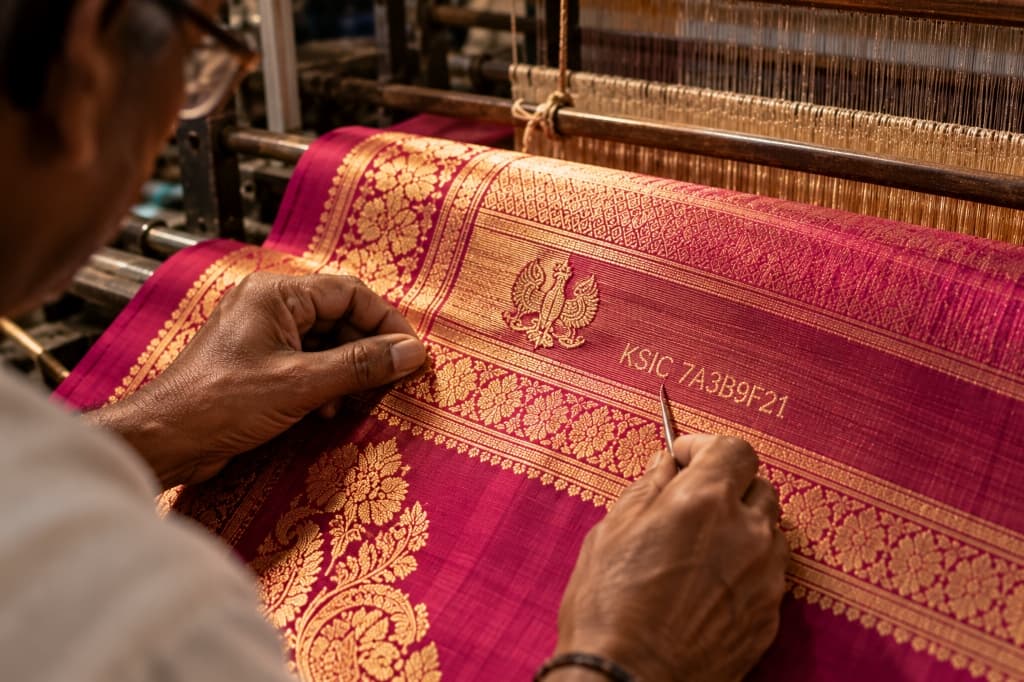
Steam ironing, cutting, a unique code, checks, then dispatch.
Sarees are steam-ironed, cut to length, marked with a code and hologram, checked, then packed for the showrooms.
65% SILVER, 0.65% GOLD
Zari is specified as 65% pure silver and 0.65% gold. Madhurya describes genuine gold and silver zari. Neither figure is extended into a no-tarnish guarantee.
WHAT THE SUPPLIED ACCOUNTS ACTUALLY SAY
Each saree is described as carrying a unique identification number and a hologram. This website does not check those numbers.
Care notes below are taken from the Madhurya article. No washing temperature or extra chemical instruction is added.
- • Dry clean, to help preserve the shine.
- • Store in soft muslin or cotton.
- • Keep away from sunlight and moisture.
- • Do not spray perfume directly on the saree.
- • Refold a stored saree every few months.